New Horizons Book Prize

•January 6, 2010 • 1 Comment

Lovely news earlier this week when I discovered Johnny Mackintosh and the Spirit of London is one of twenty titles longlisted for the New Horizons Prize. This is a county prize, organized by the Dorset School Library Service, for debut novels appealing to the 9-13 age group. A creative writing competition will run alongside the award.

Can I take a moment to say how much I love the county of Dorset, have spent much time there and think the DSLS is clearly run by a very enlightened bunch. Not wishing to influence the shortlisting process in any way, I’d add that it would be great if everyone votes for Johnny Mackintosh. I was delighted to set the fictional town of Yarnton Hill in the southwest on the Dorset/Somerset border so there’s even the added incentive of having a base for evil aliens right on your doorstep.

I also want to add how much I love the name of this award because New Horizons is also the first spaceship ever that will visit the dwarf planet Pluto – at least that’s what NASA thinks. Early on in Johnny Mackintosh: Star Blaze, the Spirit of London gets there first!

Image credit: Johns Hopkins University Applied Physics Laboratory/Southwest Research Institute (JHUAPL/SwRI)

Excerpts from Johnny Mackintosh: Star Blaze

•January 2, 2010 • Leave a Comment

With only a few days to publication of the new Johnny Mackintosh book, I’ve posted up a couple of excerpts to whet your appetites. The first is the opening page; the other is from a scene later in the book.

Publication is Thursday 7th January, but you can pre-order Johnny Mackintosh: Star Blaze from any of these sites.

Stargazing at Stonehenge

•January 2, 2010 • 1 Comment

Partway through last month I went on a trip to one of the most amazing places in Britain. The stones at Stonehenge have stood for over four and a half thousand years. There’s been a monument of some kind at the site for even longer. Our very own wonder of the ancient world was erected around the same time as Egypt’s pyramids and it’s amazing to think that, even when the Romans invaded Britain, Stonehenge was standing tall and proud as an ancient mystery.

The great thing about the visit was that I was able to walk inside the stones, after dark, with hardly anyone around. To coincide with the winter solstice, the day was organized by the Royal Astronomical Society to mark the end of the International Year of Astronomy. Archaeologists were on hand to explain the different elements of the site, while astronomers were there to talk you through the night sky above.

Sadly, the day was overcast. I was especially disappointed because the first thing one of our astronomer guides said was that Cassiopeia, Johnny’s very own constellation (his Star Mark) would have been directly overhead, set against the backbone of the Milky Way. There’s even talk of making the area the UK’s second designated dark sky park, following on from Galloway Forest Park in Scotland.

For millennia, indeed since before Stonehenge was even thought of, people have gazed upwards at the night sky in awe. The stars have driven humanity’s progress, whether it was calculating when to plant crops, navigating ships or racing to the Moon. Now it’s rare to be able to see the night sky and there’s a danger we’ll lose our interest and sense of wonder at the heavens. It’s important for our futures and those of our descendants that this doesn’t happen, and the International Dark Sky association are doing their best to fight against light pollution everywhere.

As well as the stones, the site was hosting the IYA’s From the Earth to the Universe exhibition. If that doesn’t have enough spectacular space shots for you, check out today’s entry in the Twelve Days of Johnny Mackintosh, over at JohnnyMackintosh.com.

It’s Christmas!

•December 25, 2009 • Leave a Comment

HAPPY CHRISTMAS!

It’s actually a beautiful White Christmas here in Nottingham, having snowed this morning and then turned into a gorgeous sunshiny day. I hope you’re enjoying yourselves as much as I am.

I would like to think that some of you may have been more than a little disappointed not to receive a copy of Johnny Mackintosh: Star Blaze in your Christmas stockings this morning. Well, although the new book doesn’t publish until 7th January, don’t despair.

Everyone’s heard of the twelve days of Christmas. From tomorrow, over at JohnnyMackintosh.com, I’ll bring you the twelve days of Johnny Mackintosh. Continuing every day until publication, I’ll post twelve images I’ve created or picked out that follow sequentially through the book, giving a little taster of what’s to come, but without spoiling anything.

As if that’s not enough, I thought I’d leave you with a Christmas brainteaser. Below are three anagrams, the solutions to which are chapter titles in the new book. Thinking caps on!

A Venus pro (9)

Hello Keith – try in rebel flats (2, 3, 5, 2, 3, 4, 6)

Draw on exit path (3, 4, 7)

If you believe they put a man on the Moon

•December 14, 2009 • Leave a Comment

Eugene Cernan: last man to stand (or drive) on the Moon (photo Harrison Schmitt, NASA)

Earlier this year was the glorious fortieth anniversary of the first Moon landing. Today marks the rather more ignominious occasion of humans (I could still simply write “Man”) leaving the Moon for the last time. On this day in 1972, Apollo 17’s Eugene Cernan and Harrison “Jack” Schmitt lifted off from the Mare Serenitatis and the first chapter of the Space Age ended, leaving the rest of the book unwritten.

It was claimed that, reaching the Moon was somehow an end in itself and that, less than four years on, the public had become as bored of the whole incredible affair as the politicians. In the many years since, all we’ve done is send a few robot explorers into the solar system and some people into low Earth orbit, most recently to the International Space Station (ISS). Anyone who thinks the ISS is a long way away should realize the Moon is a thousand times further – it seems almost as out of reach today as when President Kennedy made his famous speech in 1961.

Of course it’s right to scoff at the witless lunatics who disbelieve the whole glorious adventure. Even now, mirrors left behind by the crew of Apollo 11 can be used by anyone around the world with the right equipment to bounce lasers back and forth to measure the distance between us with great precision. Yet it was such a stand out achievement that you can almost understand why some, who weren’t alive at the time, are a little incredulous. The pace of technological advance appears so tremendous, yet we’re unable to repeat what we achieved all those decades ago.

At least now a return is being mooted, even if driven by a second space race. The West is being overtaken as the world’s economic powerhouse and there’s no better national symbol to prove it than to send a new generation of humanity a step further out and plant a new flag on another world. And the West is responding by dusting off plans and also looking to go back – I suspect (and hope) we’ll all end up pooling resources and journeying together.

the Moon combined with background stars (double exposure, NASA)

If we’re to survive as a species then one thing is certain – we need to colonize space. Failure to do so, simply keeping all our eggs in this one basket here on Earth, means we’ll one day be wiped out. It might happen next year (let’s hope not!) or it might take a few thousand years, but the simple rules of probability, coupled with the global catastrophic risks, make it certain. While I’m sad I won’t see it myself, I long for a day of human colonies around the galaxy, embassies on alien worlds, spaceships with mixed human and alien crews exploring together and witnessing sights we can’t even begin to dream of. I’ve always loved the words of my hero, Carl Sagan, who said:

“The surface of the Earth is the shore of the cosmic ocean. From it, we have learned most of what we know. Recently, we have waded a little out to sea, enough to dampen out toes or, at most, wet our ankles. The water seems inviting. The ocean calls. Some part of our being knows this is from where we came. We long to return.”

It’s thirty-seven years since we left the Moon – I hope it doesn’t take us so long again to return and that, when we do, we don’t stop but instead use our handily placed satellite as a stepping stone to begin our great journey to the stars.

The Alphabet: from A2Z

•December 13, 2009 • Leave a Comment

Alphabetical order always struck me as unfair. Arabella Asquith was born with a distinct advantage over Zachary Zephaniah. Even the brothers James and John sprang to rather greater prominence than their mustachioed father. I’m an egalitarian. Everyone should have an equal chance to shine. That’s why I’ve always felt sorry for the letter ‘z’ – loved it, supported it, tried to ensure it wasn’t always bringing up the rear. Almost every list starts with an ‘a’, but how often do people go all the way through to the end? Never ever – and, when they do that, poor ‘z’ is split in two:

In one verse, All Saints give us:

“Flexing vocabulary runs right through me
The alphabet runs all the way from A to Zee”

But in the next, it’s:

“Sometimes vocabulary runs through my head
The alphabet runs all the way from A to Zed”

And some words cheat – they pretend to use z. How else should Coleridge have spelt the mythical place where Kubla Khan a stately pleasure dome decreed? Perhaps the opium got to him.

The Greek alphabet has only 24 letters and z (or zeta) is right up there in sixth place. None of the other letters jostled for position, yet somehow (decreed by the great Alpha to Omega?) z was relegated all the way to the end and beyond. Even the new upstarts finished ahead of it.

At least in mathematics z holds pride of place, though only in italics. Not only is it first choice for any complex variable (if you don’t know, you don’t want to know), but the Riemann zeta function remains the greatest mathematical mystery there is – that may one day amaze us with the distribution of prime numbers.

Some people think that –ise endings are the way things have always been and it’s those upstart revolutionaries from across the Atlantic who introduced us to –ize. But they’d be wrong. It’s on these shores that spellings went awry, de-zedding the dictionary for its common-as-muck sibling, as if the language weren’t swimming in a swirling sea of smug esses already. At least Inspector Morse recognized that no Oxford don would have written ‘realise’ in a suicide note.

Happily Tibor Fischer’s excellent The Thought Gang is so deliberately packed full of zany z words that it even comes with a glossary. I don’t know if he rhymes them with me or head, but at least it shows I’m not the only z zealot.

The Sun Kings

•December 6, 2009 • 1 Comment

Eighteen months ago I went to the Royal Society’s awards evening to acknowledge the best popular science books. On the shortlist was The Sun Kings by Stuart Clark. He didn’t win, but Stuart was definitely the most fashionably dressed finalist present. We chatted for a while and he made his book sound absolutely  fascinating. I left resolving to read it straightaway, but one thing led to another and, only recently, did it reach the top of my (very long) reading list.

Sadly, nowadays I have very liittle time for casual reading – everything has a purpose. Happily, DAMTP (the famous Department of Applied Maths and Theoretical Physics at Cambridge where Stephen Hawking is based and where I occasionally went as an undergraduate) hosts a brilliant online popular maths magazine called +Plus. It’s full of zillions (to use a very mathematical number) of interesting articles, one of which is now written by me. When they wanted me to write a book review for them, I remembered my conversation with Stuart and asked if I could stretch the definition of mathematics just a little to include The Sun Kings.

The story is set around a giant solar flare observed in 1859, telling how the science of astrophysics grew out of observational astronomy. In today’s world where everything seems to be so short-term or temporary, it’s incredible to read of people making observations for decades and then their data being passed on to those who came after them to add to and make sense of.

It’s important because our island Earth isn’t as isolated as we might think – the Sun has a major influence on what happens here. Our home star goes through an eleven year cycle of magnetic activity that is currently building towards a maximum (between 2011 and 2013). On the downside, satellites are likely to be damaged and our mobile phones might stop working some of the time. On the plus front, there should be more beautiful auroras, like in the banner at the top of this blog.

With Johnny Mackintosh: Star Blaze not coming out until January, it’s well worth putting The Sun Kings on your Christmas list and taking a look at +Plus, to give you a picture of just how interesting maths can really be.

The Great Blogging Wilderness

•December 2, 2009 • Leave a Comment

Shame-faced, I’m emerging from a long period in the blogging wilderness. At least I haven’t been idle. In only a few short weeks the second book in the Johnny Mackintosh saga will be published.

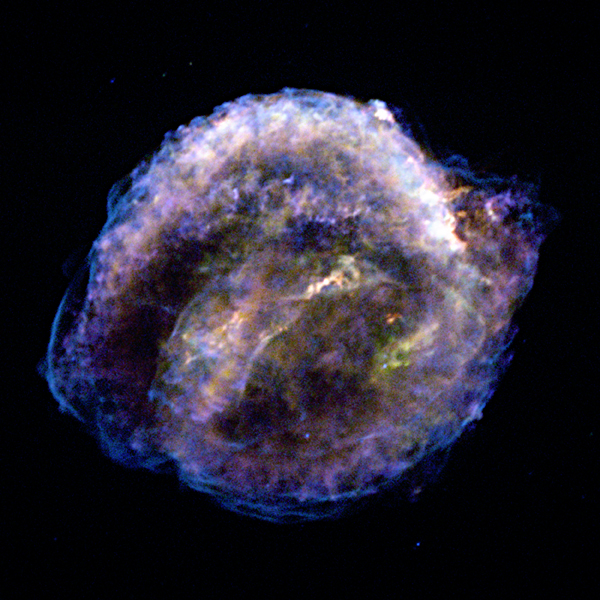
Kepler's Supernova (Credit: NASA/CXC/NCSU/S.Reynolds et al.)

Johnny Mackintosh: Star Blaze will be available from 7th January. The story begins nearly six months after the end of Johnny Mackintosh and the Spirit of London. The Star Blaze of the title is how the majority of the galaxy’s inhabitants refer to a supernova, the stupendous explosion that occurs when a giant star runs out of fuel at the end of its life and collapses. These events appear rare – the last one observed in our Milky Way was seen in 1604, now known as “Kepler’s Supernova”.

This beautiful picture, put together using images from the Chandra telescope, shows the nebula left behind following the explosion witnessed with the naked eye (there were no telescopes then) over four centuries ago on Earth.

When they happen, supernovas produce more energy in their gigantic blaze than all the rest of their galaxy combined – anything in the path of the explosion has no chance of survival. Johnny’s fear is that Earth is very much in danger…

Happy Birthday Johnny Mackintosh!

•April 23, 2009 • Leave a Comment

Today, there are celebrations right across England – it’s Johnny Mackintosh’s birthday. Some might say the public are raising their glasses to the bard, for the 23rd April is also Shakespeare’s birth (and death) day. More likely still, they might claim pubs up and down the land are full to celebrate St George’s Day, that noble slayer of dragons. Isn’t Johnny every bit as heroic?

If Johnny were especially lucky, he might have a cake a little like the one baked for my birthday last year:

johnny mackintosh birthday cake

Readers of Johnny Mackintosh and the Spirit of London will know the book opens on Johnny’s birthday, but it wasn’t originally 23rd April. If I remember, I set the first day of the early drafts as 14 April, but eventually decided I needed to move a little later in the month for the chronology to coincide better with the final day of the football season.

Growing up in Nottingham, every year I’d participate in the St George’s Day Parade (as a cub and then scout), which was generally a pain as it often coincided with the FA Cup semifinals (only highlights) on the TV. It’s hard for people to imagine how starved of televised football we were back then.

More recently, St George seemed to have fallen out of fashion with the absurd position the English couldn’t celebrate our own patron saint. Here in London we’re still in the frankly rather strange position where we have a huge parade from Trafalgar Square on St Patrick’s Day (the patron saint of Ireland) yet there’s normally been next to nothing for St George himself. No offence to our Irish neighbours who I love dearly, but happily George is returning to prominence.

There are also celebrations for Shakespeare at the Globe on the south bank. Being a writer, it’s impossible not to be aware of the shadow of the most famous ever Britain, who looms over all our work. When I moved the date to 23rd April it was actually with a nod to the bard, as I’d heard that he lived in Shoreditch, which is the same part of London as me. Just before Christmas, the site of his original theatre was discovered about half a mile from my house. There’s not a lot left, as it was deconstructed in Shakespeare’s own lifetime with the timbers removed to be used in the building of a new theatre to show off his plays – the Globe. It would be funny if, one day, while performing Henry V there, the final line of the opening scene of Act 3 was spoken as:

Cry ‘God for Harry, England, and Johnny Mackintosh!

AddThis social bookmarking image button

World Book Day in Hackney

•March 2, 2009 • Leave a Comment

wbd_logo_09_wwwnbt_rgbThursday March 5th 2009 is World Book Day, but only in Hackney, the other parts of the UK and in Ireland. The rest of the world celebrates World Book Day on 23rd April, coincidentally both William Shakespeare’s and Johnny Mackintosh’s birthdays, but here in the British Isles we like to ignore our famous sons and do things a little differently.

Hackney is close to where I live in London. Shakespeare’s original theatre is there, where he performed in person as well as having his plays first staged (before it was dismantled and the timbers used to construct The Globe on London’s south bank). Nowadays it’s home to another theatre, the famous Hackney Empire, and is represented in Parliament by Diane Abbott MP (a regular on my favourite telly show, This Week).

Throughout its history it’s been a haven for free-thinkers, partly because it’s just five miles outside the centre of historic London which meant people were able to give speeches there criticizing the state and the church that weren’t allowed any closer in (by an Act of Parliament long before Diane Abbott’s time).

It’s also where I shall be giving a little talk on World Book Day. I hope this shan’t be too subversive, even though I’ll explain how time travel is possible and why aliens are almost certain to exist in our galaxy, as well as discussing whether or not there was ever a real place called Atlantis.

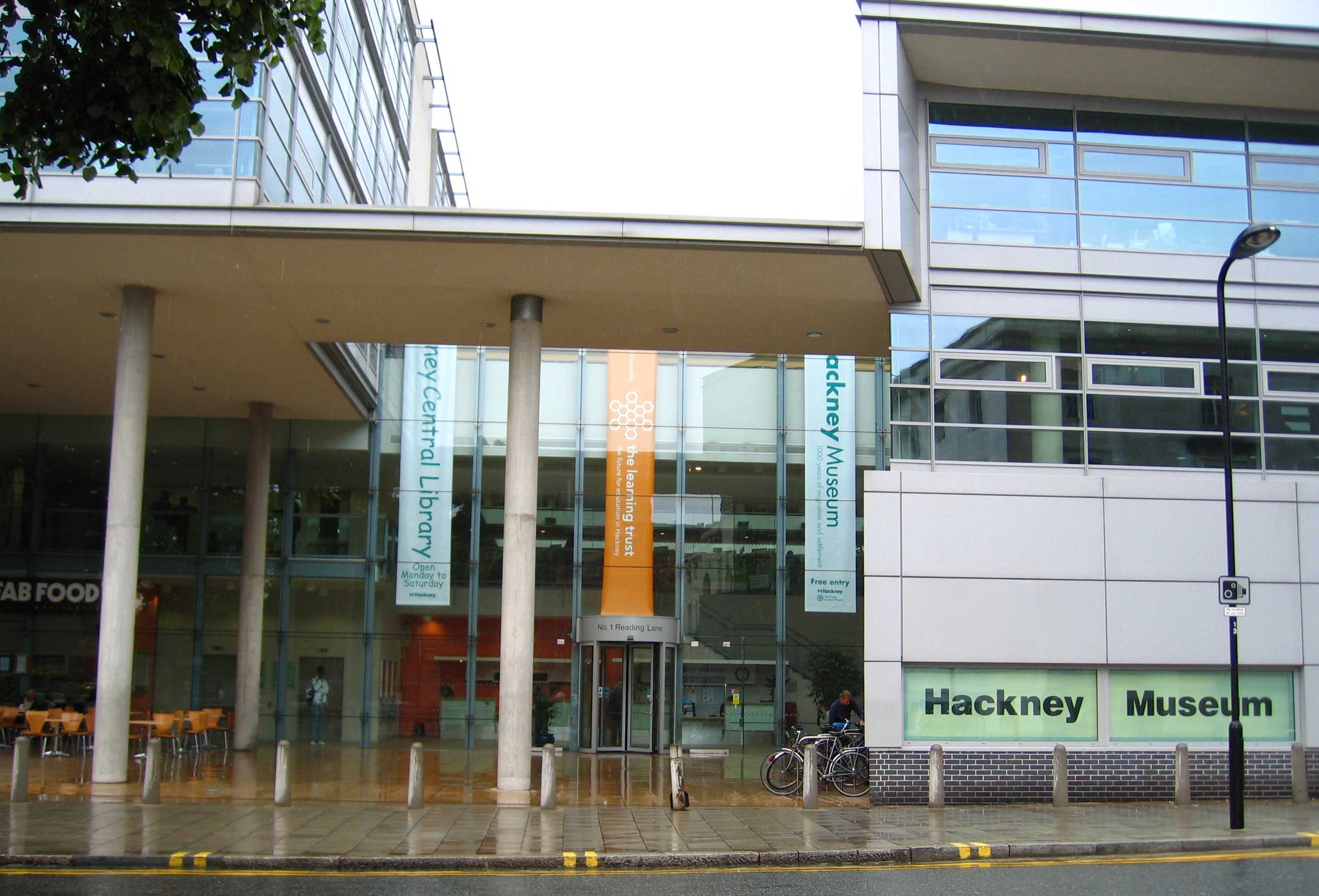
hackney-museum-libraryIf you want to listen and even get yourself a signed copy of Johnny Mackintosh and the Spirit of London, make your way to the Hackney Museum and Library for 4.30pm. The full address is

Hackney Museum

1 Reading Lane

London E1 1GQ

The event’s been organized by the fabulous Victoria Park Books and I’ll be there until around 6.30 and will be talking with two other writers, Belinda Hollyer and Gaby Halberstam. For younger readers, there’ll be some other authors too: David Lucas, Kevin Waldron, Carolyn Hink, Guy Bass and Will Gatti. We all look forward to meeting you.
AddThis social bookmarking image button