What do we want to do when we grow up?

•January 2, 2011 • 1 Comment

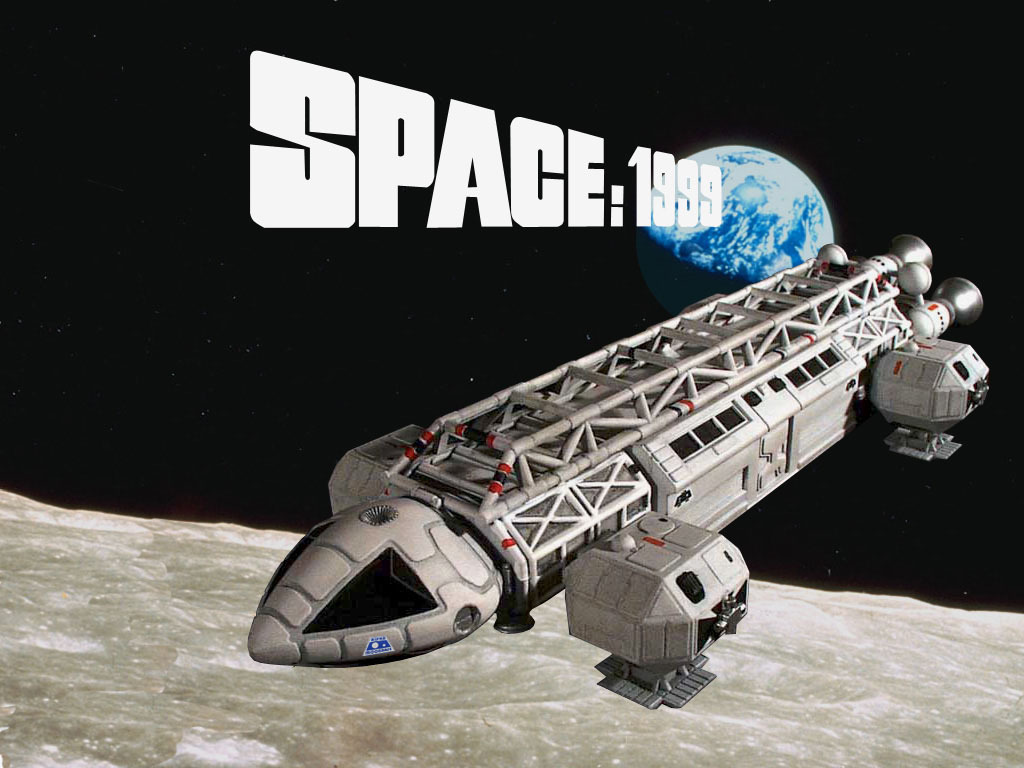
When I was a kid the brilliant Space 1999 was in its pomp. This was in the mid-1970s. As a family, we’d recently moved back from America, but the Moon landings were still fresh enough in the mind to believe that, by the year 2000, space colonies would be everywhere. I figured I should run the biggest, most important one (naturally), so decided that Commander of the future Moon base would be a good career choice. So far, things haven’t worked out, though if any of you can get to the Imax3D movie Magnificent Desolation: Walking on the Moon, you absolutely have to do it. When I was working on the Science of Spying at London’s Science Museum, I was able to go loads of times, and never once got tired of it (occasionally I’d see Space Station 3D instead, but it’s just not the same).

The Science of Spying

I also expected to be a writer. I’ve still kept my early notebooks and must digitize them so I can put a couple of stories online and you can see the early inspiration for Johnny Mackintosh. Then, I did kind of expect to be a footballer at some point. I was captain of the school team and we were pretty successful, so to an 11 year old it seemed a small step up to become a professional.

Sometimes my ambitions were a little more down to Earth and I thought about going into politics. I was going to be the leader of the first world government, bringing peace to mankind and unifying our efforts to colonize space. During my teenage years I heard about the PPE (Politics, Philosophy and Economics) course at Oxford University and decided that would be a fun thing to study (in fact it’s exactly what the current British Prime Minister, David Cameron, and many of his peers, did), but as I approached the sixth form I began to get sidetracked.

I do remember my English teacher taking me aside after one lesson imploring me to study English literature at ‘A’ Level, but despite my love of writing, by this point I’d been bitten by the beauty of mathematics and physics. It’s a great mystery why the universe seems to run along mathematical lines, but we should be grateful it does. Hence I went to Cambridge University to study mathematics (with physics). You can read a little of how that turned out in a career interview I recently gave Plus Magazine.

The great thing is, that you never grow out of growing up. People say “40 is the new 30” and the world (and beyond) still seems full of possibilities. It was only three years ago that I applied to ESA to become an astronaut and, as we enter another year, I’d encourage everyone to dream great dreams and do your best to turn them into realities. I don’t know what I want to be doing in, say, 20 years’ time, except that I’ll always have a notebook with me and be writing something.

On Radio Five Live in Support of Harry Potter

•October 18, 2010 • Leave a Comment

Last night, I plucked up the courage to ring Dotun Adebayo’s Virtual Bookshelf. Readers of this blog will know I’m a fan. Normally nowadays I can’t listen live, as the phone-in takes place between 2am and 3.30 (not great when you have to out the house for 6.30 to get to work). However, I’ve taken time off to write Johnny Mackintosh’s third adventure (provisionally Battle for Earth) so I, like Dotun, can afford to be up all night.

I telephoned to nominate Harry Potter – the entire series – for a place in the list. Dotun, lovely man that he is, allowed this, which did rather set the cat amongst the pigeons. Do the rules of the Virtual Bookshelf allow a boxed set? Everyone hates listening to their own voice but, for the next few days only, that shouldn’t stop you hearing my praise of the boy who lived and his magnificent creator on the bbc i-player: http://www.bbc.co.uk/iplayer/console/b00vc2dl/Up_All_Night_18_10_2010

I’m between 1:21:25 and 1:29:30 (a whole 8 minutes).

The nomination caused much heated debate, with many voices against (and every vote against cancels one for), but at the end of the phone-in Harry won the day and made it on as Book 60. However, Harry Potter still needs your help. Next week, Dotun and his literary reviewer (last night it was Hephzibah Anderson) invite listeners to remove one from the most recent ten titles on the list. Harry creates strong feelings in people and Dotun suggested he was in danger of being removed after only one week.

Don’t let that happen. I propose the AA Road Atlas of Britain (currently in place 51) should go as it doesn’t really compare with Rowling’s great work – I would be more lost without Harry than I would without a map. So next Sunday night/Monday morning, I say the atlas has to go.

The Man Booker Prize Readings at the Royal Festival Hall

•October 10, 2010 • Leave a Comment

In two days’ time, the award of the biggest literary prize in the UK publishing calendar will be announced to much fanfare, live on the BBC 10 o’clock news to an audience of millions. When you consider actual sales, revenue and public interest compared with the music, movie or gaming industries, it often appears the publishing industry punches far above its weight in garnering such publicity.

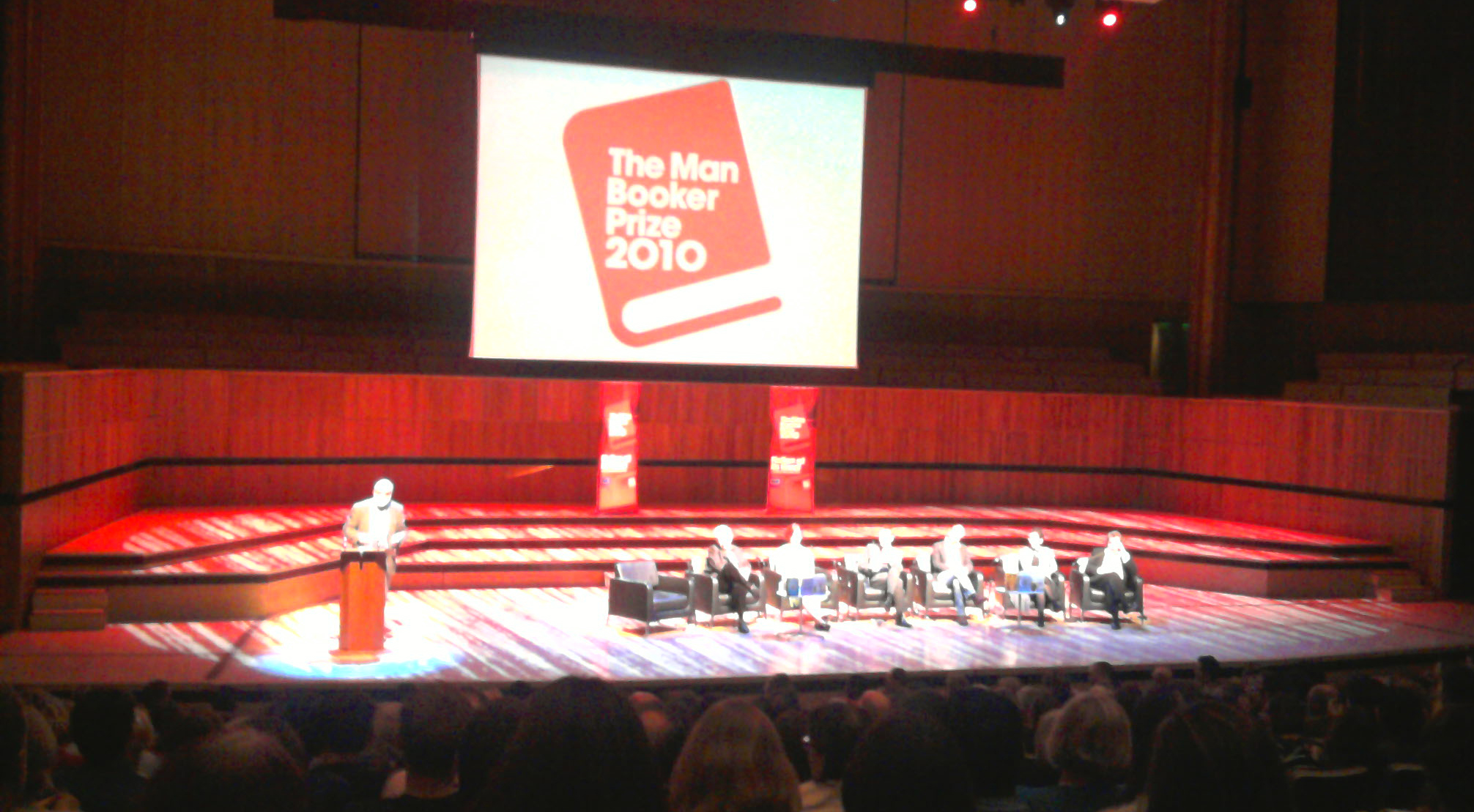
Tonight saw an example of that. The beautiful auditorium of London’s Royal Festival Hall was only three-quarters full for a preview of the Man Booker Prize night, with all six short-listed authors present, supposedly to read from their work and answer questions. Sadly, no audience questions were possible as the idea of putting microphone stands in the aisles for people to gather behind had escaped the organizers – oh well, at least we had six very different readings.

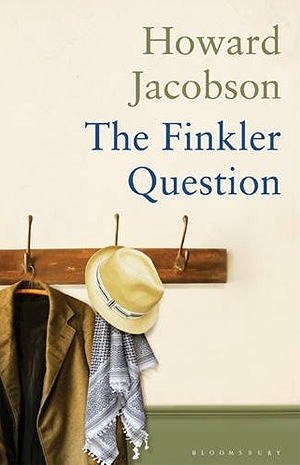
First up was Howard Jacobson with his The Finkler Question. Jacobson’s been longlisted twice before, but this was his first time breaking through into the final half dozen. He talked a bit about how important it was to him to write a funny book and wondered how far you can take the humour when a tale descends into tragedy. The Finkler Question is a story of three Jewish men, their friendship and how they deal with grief. For Jacobson, the key character of the three is the widower, and his reading was of a first date for this man after the loss of his wife of fifty years. It was a powerful, engaging and funny opening to proceedings.

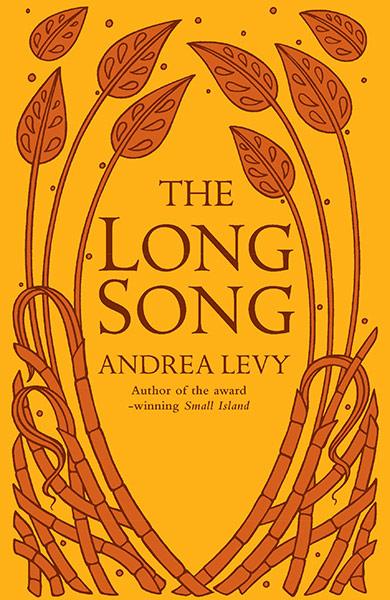
Andrea Levy came next with her The Long Song. I’ve read her Small Island, winner of the anachronistic (women only) 2004 Orange Prize for Fiction. I struggled with that as no one seemed to come out of it well – for me to enjoy a book I need some kind of empathy with it. Here, the move from Queen’s English to Jamaican reading accent was fabulous and whisked you straight into the slave revolt of 1831/32. Typical of the way Levy intertwines her stories and the links between slave and free, black and white, the main character is the slave girl daughter of a slave and the slave overseer. Of course such offspring were common. Levy ended her reading with the image of rebellious slaves being gunned down mercilessly and the chilling line that there would be “Compensation for the owners for the loss of their property”. Harrowing stuff.

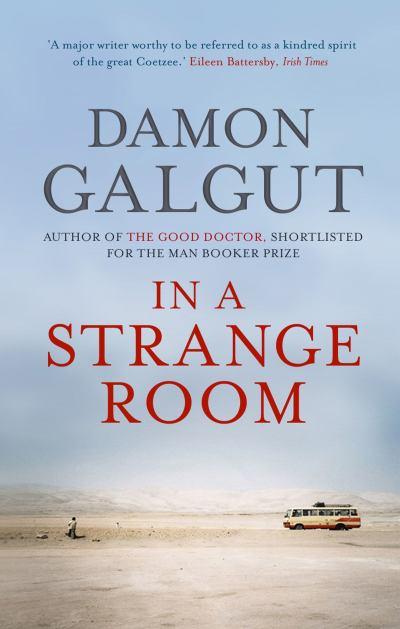
South African Damon Galgut spoke of how his previously shortlisting for The Good Doctor in 2003 had transformed his literary career. As each author spoke their cover was projected five metres tall in the background and we could all read “Author of The Good Doctor Shortlisted for the Man Booker Prize” in very large letters on the current cover behind him. He said his new novel In a Strange Room was about journeys and he read a passage about a mentally set adrift woman drinking when she knew full well it interfered with her medication. There were occasional worthwhile images, but it struggled to hold my attention.

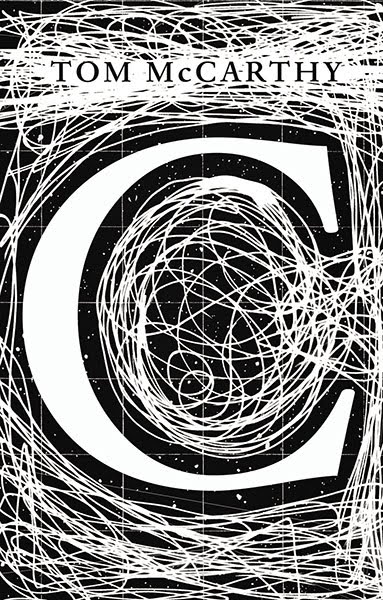
Next came Tom McCarthy, defiantly refusing to acknowledge his third novel, simply entitled C (were the first two A and B, I wonder?), as experimental. McCarthy’s prose is so dense it’s like poetry. He described the book as about being “in media” or “in language” and read a passage about its main protagonist Serge, from around a century ago. The language was hard to follow and inevitably, with a character so named, I started humming Kasabian. Betting on the winner was suspended for a while last week when a bookmakers had taken a run of money on McCarthy. He acknowledged his favourite’s status with a wry smile.

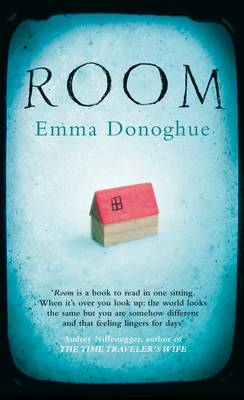
When the appalling, horrific story of Josef Fritzl’s kidnapping, imprisonment and incest with his daughter emerged a couple of years ago, I suppose it was inevitable that the literary or cinematic adaptations wouldn’t take long to follow. Emma Donoghue’s Room is one such reimagining, told from the point of view of five year old Jack whose life has been spent in a single room. Donoghue told us that, for the first time, she was to read from a section of the book when Jack and his mother are brought outside the room, to “the clinic”. When asked why she’d written about such a topic, she argued that the book was more about parenting than about the Fritzl case itself, but it felt unconvincing. Also, in her reading, I didn’t feel the extract maintained the five-year-old’s voice throughout. There was, though, an allusion to the house elves of Harry Potter, but that only served to me to suggest a lack on imagination on Donoghue’s part. I prefer my authors to create their own stories.

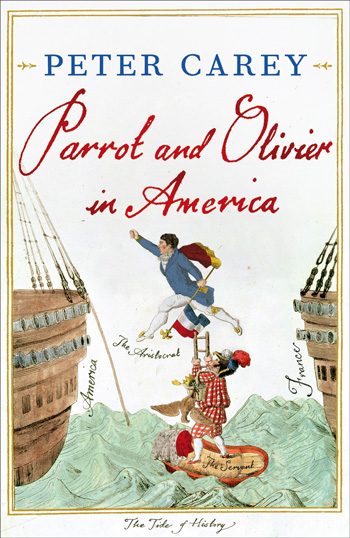
Last up was twice previous winner Peter Carey. In my twenties, living in Oxford, everyone I knew (including me) read and loved Carey’s Oscar and Lucinda, winner in 1988. With True History of the Kelly Gang triumphing in 2001, Carey could become the first author to win the award three times. Carey lived in New York for twenty years and found himself relating to Alexis de Toqueville’s Democracy in America (1830). His latest story, Parrot and Olivier in America, follows Olivier (a French aristocrat I think modelled on de Toqueville) and his English servant, Parrot. Unlike Levy’s reading, Carey made no attempt to recreate Parrot’s apparent west country accent, telling the audience we would doubtless imagine it perfectly when reading on the page. The writing sounded as polished as ever, but the story for me sounded as though it lacked passion.

What amazed me was to learn that the longlist of 13 and its shortlist of 6 was drawn from only 136 entries. No wonder it’s a collection of the same old names, year after year. When a shortlisting can make such an astronomical difference to a book’s sales, surely this suggests a dereliction of duty by publishers to their authors in not putting enough titles forward for the honour of being “the best novel of the year written by a citizen of the Commonwealth or the Republic of Ireland”.

As to who will win, on the evidence of tonight, and the passion he showed about the subject and his characters, and for surprising me in terms of which title on the list I would like to read first, it should be Jacobson, but I was strangely drawn to McCarthy’s poetic prose too. We’ll all find out on Tuesday evening.

Inception and Lucid Dreaming

•September 19, 2010 • Leave a Comment

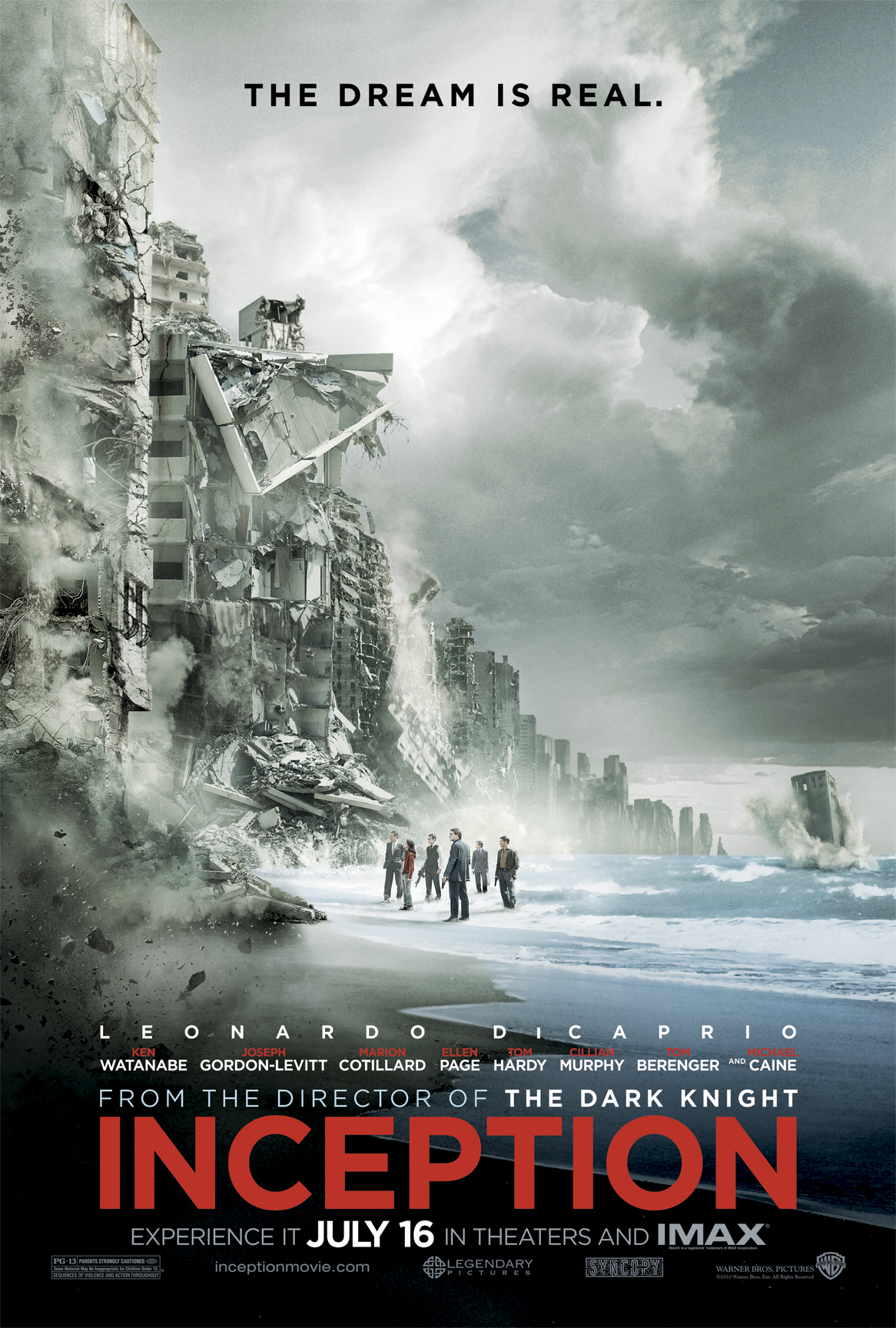
My earliest memories are dreams. In the very first I awake up on a beach in China, with snakes coming out of the sand. How could I not love the opening of Inception, Leonardo DiCaprio’s Cobb in the surf with a pagoda in the background?

I’ve been blessed with cinematic, powerful dreams all my life. Sometimes I’ve lived a lifetime in one night – I didn’t know other people had experienced that but, in Christopher Nolan’s film, the characters grow old in the dream, only to wake up young again the next morning. Often, I’ve died in my dreams, so it was good to see that Nolan’s film didn’t promote the popular misconception that if you die in your dreams, you do in real life. In the movie, as in my dreams, it means you (normally) wake up.

Lucid dreaming is having the ability to be aware that you’re dreaming and remain in the dream to control it. The classic conundrum is to know what is the waking state, the “real” world, and what is the dream state. A corollary is to ask which is more important. Read Andre Breton’s Surrealist Manifesto and you may easily become convinced it’s the dream.

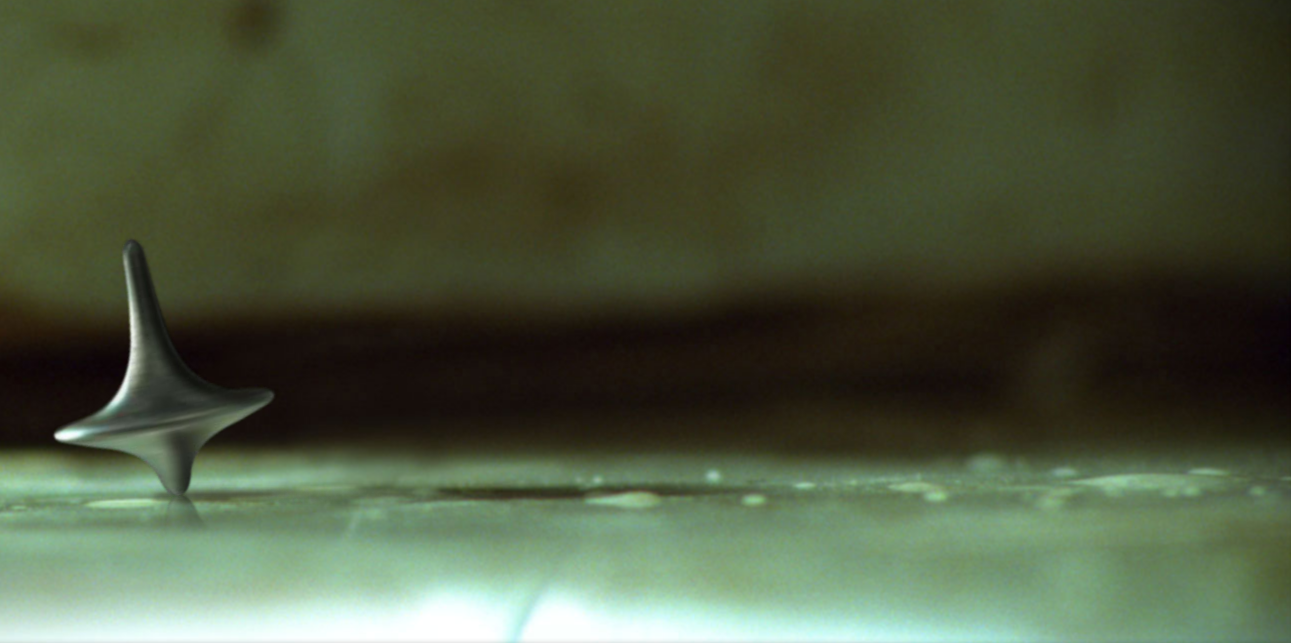
In the film the characters carry personal totems so they can tell if they’re dreaming or not. Cobb is never without a small spinning top that apparently only topples in the real world. In dreams it can spin forever. The technique I tend to use is to deliberately look at a scene or view, turn away, turn back and look at it again – if it’s changed it’s an indication I’m in a dream world rather than reality.

When you discover you’re dreaming, the secret is to remember this while staying in your dream. Do that, and you can do anything you want – literally. You become a god, in charge of everything and anything. My first step is normally to fly – there are few things more liberating than swooping across the sky feeling the wind on your face. Sometimes you change your form – if battling a gigantic monster of some description, I reckon I’ll be more successful if growing razor-sharp claws (and just growing).

The Penrose staircase

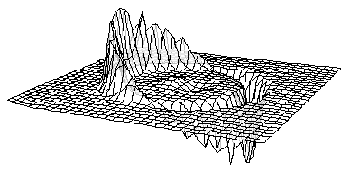
A slight disappointment of Inception was the lack of “physics”. Near the beginning of the film, new architect Ariadne (played by Ellen Page) asks the question about changing the laws of nature and folds the world in on itself, but that seems to be where it ends. There’s just one later point where Tom Hardy’s Eames magics himself a bigger gun, but that’s all. On the whole, the rules of reality seem to permeate all levels of the dream worlds within the film. A nice touch though, was the inclusion of impossible objects, specifically a Penrose staircase that the characters referred to by name. I’ll be sure to mention it when Sir Roger’s next in my office.

The dream within the dream is a very common by-product for lucid dreamers. Many’s the time I’ve woken up, spent most of the day at work, only to wake up, realize I’m still in bed and now late, got up and spent most of the day at work, woken up again and discovered that was all a dream too, and so on. My bosses have always been very understanding, but it can be hard to keep track of what you’ve done and what you’ve only dreamt you’ve done.

The holy grail for lucid dreamers is to share their dreams. In the film, the characters use drugs to access other people’s dreams. A technique I’ve tried with people on several occasions is to arrange to meet at a certain time of the night (say 4am) in a place we’re both very familiar with. The idea is to go there in our dreams, have a conversation or go on a trip together, and then discuss it in the real world the next day and see what happened. Sadly, I’ve only rarely got there myself and have never met up with anyone else.

I’m thrilled Nolan has brought questions about the reality of the dream world to a mass audience in the way he has. The biggest question surrounding the film is whether the whole thing is a dream, in Cobb’s (or even someone else’s head) or whether the wrapper at the start and finish of the film is, indeed, reality, with dream states only taking place in between. The most conventional reading of the film would probably be the latter viewpoint, yet there are hints towards the alternative interpretation.

Cobb & Mal on the beach

At one point Cobb’s supposedly dead wife Mal (Marion Cotillard) suggests to Cobb that his life of being chased around the globe by nameless organizations can only be a dream state and he needs to wake up so they can be together again. Also, a theme in the film is that you can tell a dream because you don’t remember its beginning – you magically appear in a particular place with no recollection of how you got there. At the film’s end, Cobb seems to have achieved all his goals and is in his home with his children and their grandfather, yet he just appeared there – there was no journey involved from the airport to wherever he lives.

In the end, that doesn’t matter to the main protagonist – maybe Cobb’s in “limbo” or maybe he’s found redemption in the real world but, whichever is true, he’s with his children and that’s what matters to him. The ambiguity of the ending is something that echoes Verhoeven’s magnificent Total Recall. If Cobb has retreated into his own fantasy world, then the ending is strikingly similar to Nolan’s early Memento, where the main protagonist’s blissful self-deception is only revealed at the end of the movie.

I hope something that sets the Johnny Mackintosh books apart from other books aimed at a similar audience is their ambiguity. The world’s a complicated place and I have little time for stories that are very black and white. Readers familiar with my stories will certainly recognize how important dreams are in the books. Nolan’s triumph is to have created a thoughtful, fantastical world around ideas I’ve always loved. It didn’t appear as complex as some critics have suggested, but I look forward to a second viewing just in case.

Dotun Adebayo’s Virtual Bookshelf

•September 12, 2010 • Leave a Comment

If you’re a literary insomniac, there can be no better way of spending one evening a week than by listening to Dotun Adebayo’s Sunday night (or, more accurately, the early hours of Monday morning) Book Phone-In on BBC Radio Five Live.

From 2.00-3.30 am, renaissance man Dotun, together with a literary partner, discuss the wonderful world of books, from the perspective of people who are passionate about reading and good writing. When I didn’t have a day job I’d often write through the night, so the show would make for an inspiring backdrop. Nowadays, I have to be up by 6.30 every morning so I’m not always able to follow it and that’s tricky because of the ambitious change in the show’s original format.

The current goal is to build a virtual bookshelf of a hundred titles, nominated and voted on by members of the public. The very first title was the Oxford English Dictionary, coincidentally chosen on the very morning in April 2009 that I began working for Oxford University Press. Over the next 100+ weeks the remaining titles will be chosen.

To give more information on the show, how to nominate and all the books currently on the shelf, I’ve created a separate page on this site. Clicking on Dotun’s smiling face will take you straight there.

Astronomy Photographer of the Year 2010

•September 12, 2010 • Leave a Comment

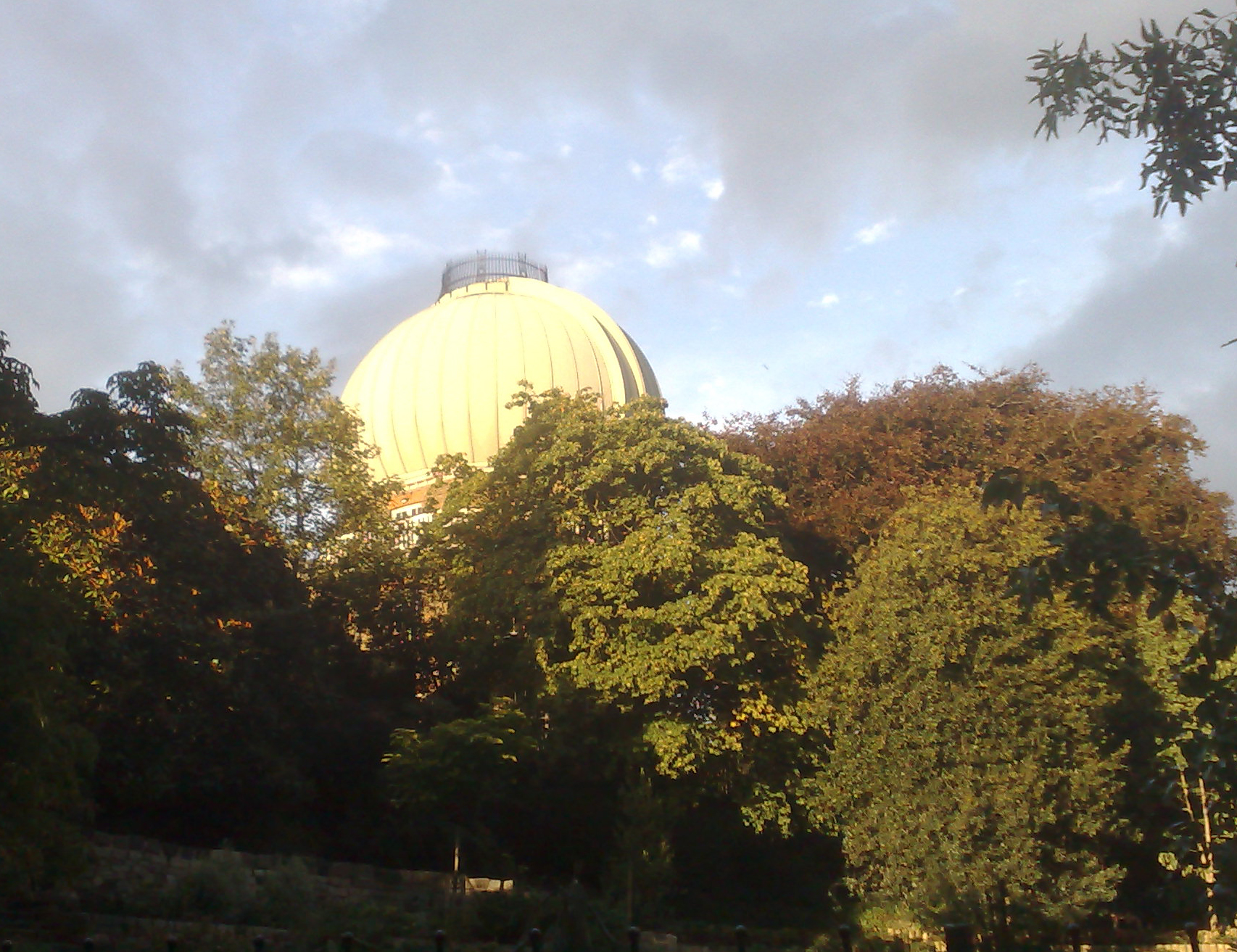
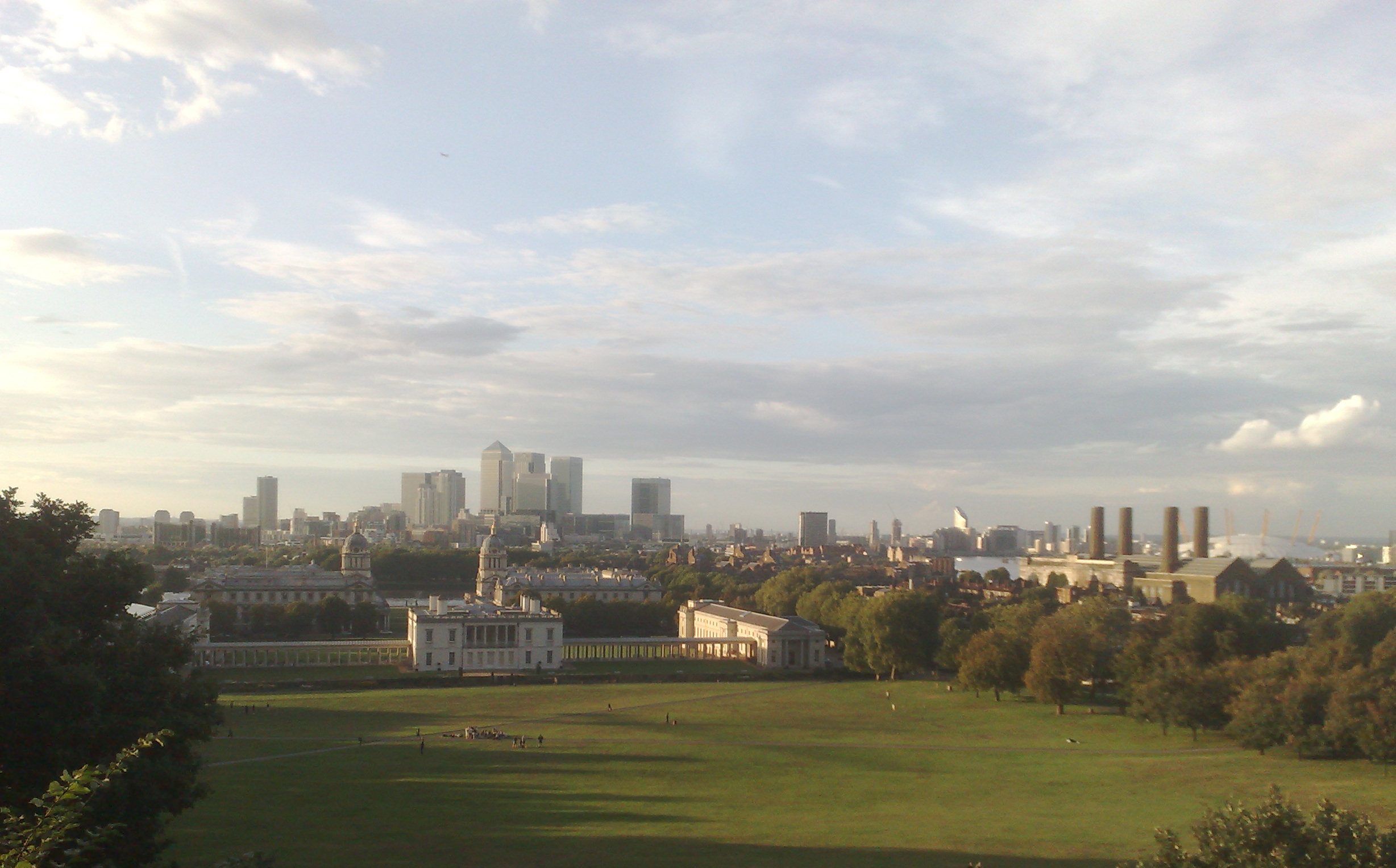
The Royal Observatory at Greenwich is a magical place. It houses London’s only planetarium, together with some great spacey exhibits. It’s also where east properly meets west at the Prime Meridian, and home to a wonderful array of telescopes, as well as a splendid earthly view looking out towards Canary Wharf. Finally, you can get there via the Docklands Light Railway which means, if you’re very lucky, you can sit in the front of the front carriage and pretend you’re driving the train out to it.

The daytime view from the Royal Observatory

On Thursday I was lucky enough to be invited there for the Astronomy Photographer of the Year Awards 2010 (thanks to my friend Anna who worked on a series of astrophotography Tutorials to accompany the exhibition). I’m fortunate that in my day job (when I’m not writing Johnny Mackintosh books) I get to travel the world, going to many scientific conferences, so can reveal that all the other scientists are jealous of astronomers because of their beautiful photographs and the way they can capture the public’s imagination.

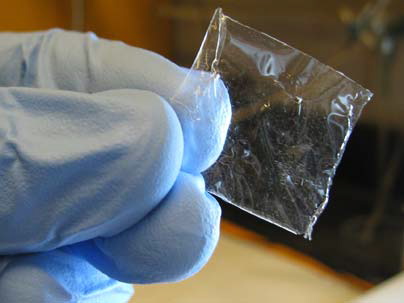
Fuel Cell Photo, courtesy Avni Argun and Nathan Ashcraft, MIT

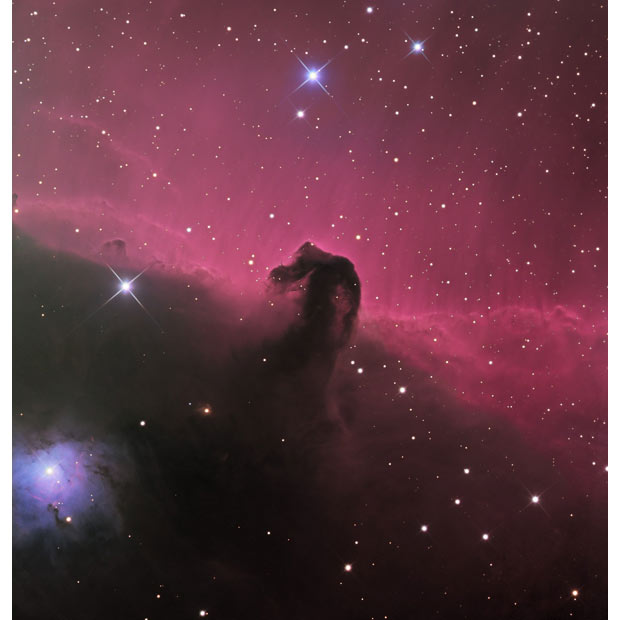
The Horsehead Nebula

Would you rather look at this MIT photo of a new fuel cell membrane (of course enormously important research) or of the Horsehead Nebula? However important the science, it’s no contest really. This Horsehead Nebula image won the 2009 Competition for amateur astronomer Martin Pugh. It helps show that, even now in the twenty-first century, amateurs can and do make a great contribution to this particular science.

There were several categories:

Earth & Space

Our Solar System

Deep Space

Young Astronomy Photographer of the Year

People & Space

Best Newcomer

Like the Costa Book Awards, the overall winner is chosen from the victors in the different categories. The awards were sponsored by Sky at Night Magazine and photo-sharing site Flickr.

The great team at the Royal Observatory had put together a planetarium show with all the shortlisted entires – it’s a breathtaking watch. Before the winners were announced, from all the pictures I saw I picked out three personal favourites:

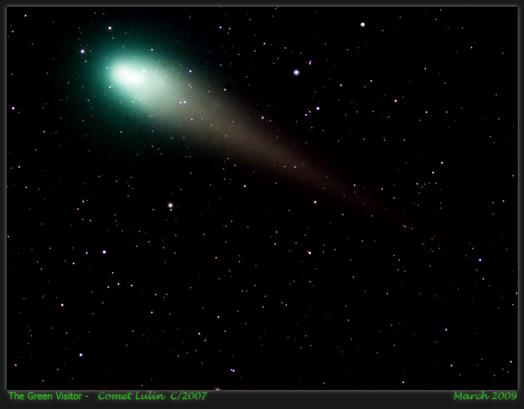
The Green Visitor by Richard Higby

Richard Higby was only highly commended for this photograph of Comet Lulin, but I thought it was one of the most impressive entries. It’s a beautiful image that it’s a once in a lifetime opportunity to snap. But it’s much more than that, with the coloration telling us much about the chemical makeup of the comet, in this case revealing the presence of special, diatomic carbon molecules (C2).

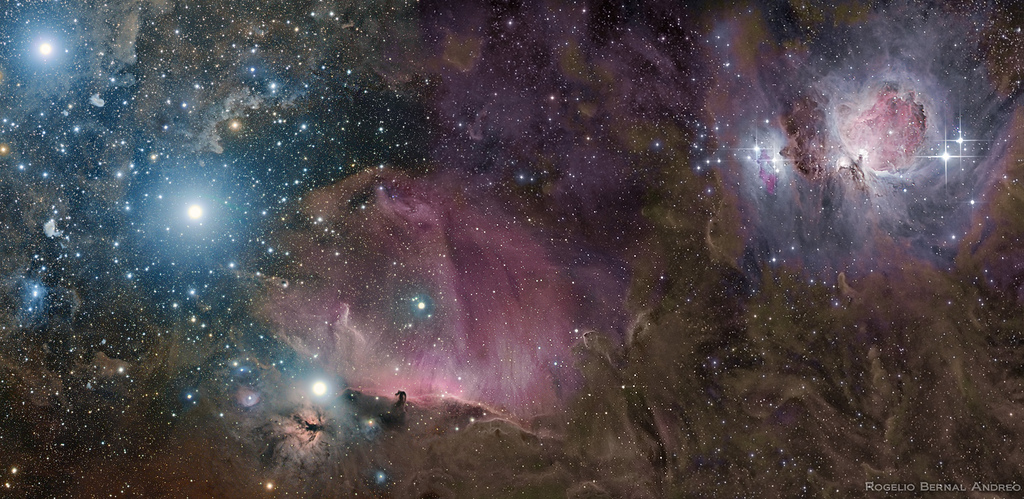
Rogelio Bernal Andreo's Orion Deep Field

Rogelio Bernal Andreo produced an incredible wide-field shot of the area of space around Orion’s Belt, to win the Deep Space category. I especially loved the image because it includes Alnitak and the Horsehead Nebula, two places that feature prominently in the Johnny Mackintosh books. It’s incredible that a land-based amateur photographer can bring us something like this, that I’ve only seen the like of in Hubble Images before. I’d suggest it didn’t win overall, partly because it is a little like the type of spectacular astrophoto we’re already used to, and partly because of the subject matter being too close to last year’s winner.

The third image I especially liked proved to be the overall winner, and was Tom Lowe’s Blazing Bristlecone, so named because of the way the Milky Way mirrors the shape of the Bristlecone pines. With my artistic hat on, I’d say the composition’s excellent. With my scientist’s hat on, I fear a little for because the beauty of the Milky Way, something that was a commonplace sight for every human being who’s walked the planet until the last few decades, is now lost to all too many people.

With global light pollution preventing us from looking skyward, where will the next generation of astronomers or scientists generally come from? That’s why competitions such as this, and the dissemination of other spectacular images by the world’s astronomers and space agencies are so important – that and that they’re just so magnificent and beautiful.

Tom Lowe's Blazing Bristlecone

On a final, popularization of science note, it was tremendous to meet up with some many people in the same location who have this shared desire to inspire the next generation of space scientists, but I couldn’t help thinking we could have been in big trouble had a comet such as Lovin piled into the Royal Observatory and vaporized the community in one fell swoop.  Perhaps there should be a rule tha everyone shouldn’t be in the same place at once, the same way that the secret formula for Coke lives on?

Happily, that didn’t happen, so and everyone can visit the exhibition for free until the end of February next year. If you can’t make it to Greenwich, then do at least pay a visit to the Flickr group.

The Universe: The Big Questions

•September 11, 2010 • 2 Comments

By definition, the Universe is a pretty big place, so the questions we ask about it tend to produce suitably mind-boggling answers. That’s one of the reasons why astronomy and cosmology can be such fascinating subjects.

Stuart Clark, author of The Sun Kings, has just published a new book in the Quercus Big Questions series called “The Universe”. Last Wednesday, he gave a talk on those same questions to a packed audience at the University of Hertfordshire. It was so popular that nearly a hundred people had to be turned away. I’m disappointed for them, but thrilled that popular science and, especially, astronomy, has really caught the public’s imagination.

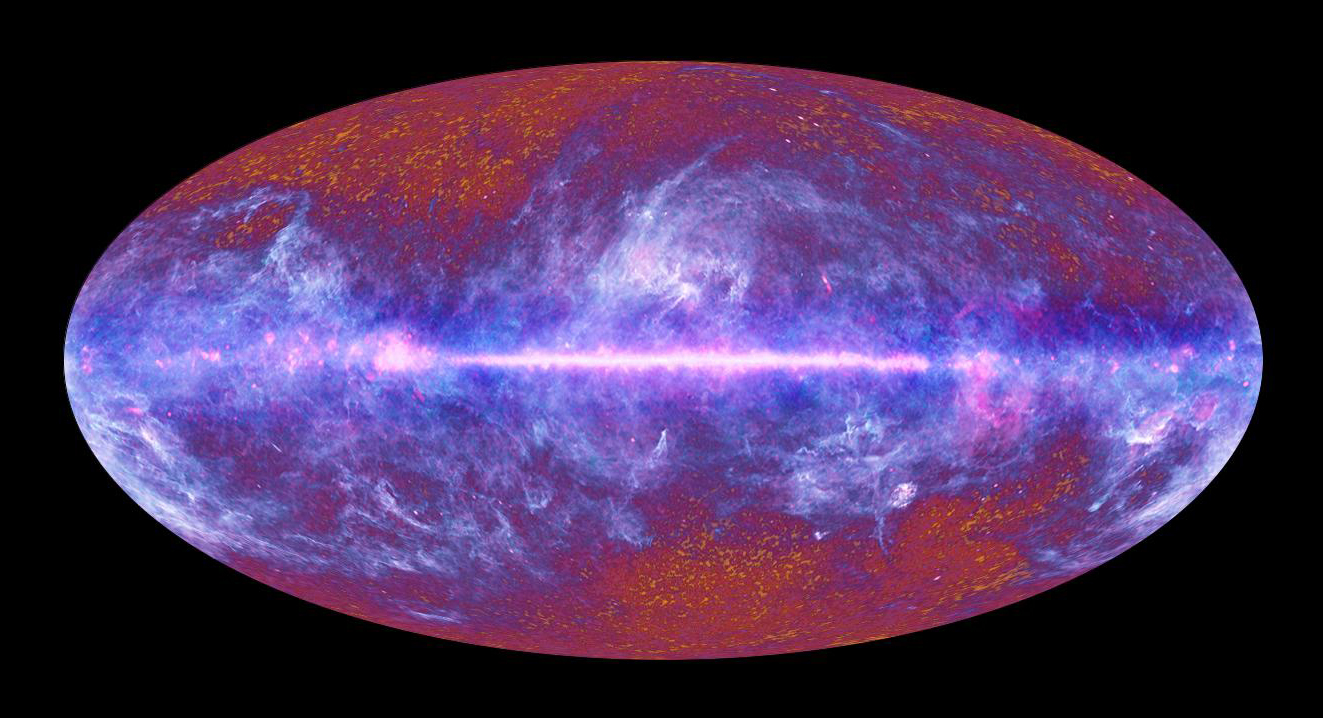
The book covers twenty questions you might want to ask about the Universe, beginning with “What is it?” and going all the way through to asking “If it had a creator”. I didn’t expect Stuart to be able to cover everything in between in an hour and a quarter, but he managed the contents list impressively. Especially when he began by showing this image from the European Space Agency’s (ESA’s) Planck observatory/telescope and saying that here is everything that is, that ever was and that ever will be.

The first thing to say is that there were more questions than answers. It was refreshing to hear a scientist speak with such an open mind, without claiming that all the major debates are settled. The talk flowed very well, and some of the questions covered were:

What is the Universe?

How old is the Universe?

How did the Universe form?

What were the first celestial objects?

Can we travel through time and space?

What are black holes?

What is dark energy?

How will the Universe end?

Stuart didn’t talk about the aspects of relativity theory that allow time travel into the future, instead showing a representation of the Alcubierre Drive that, theoretically, could allow for faster than light travel, surfing a self-generated wave of antigravity. Personally, I found the discussion on the very first celestial objects the most thought-provoking. Afterwards we went for a beer in a local Hatfield pub and the conversation moved onto the astronomically connected music of Canadian rockers Rush, with songs such as Cygnus X1 (the first black hole candidate to be discovered) and Natural Science.

If anyone has a question about the Universe not covered in the book, feel free to ask it in a comment here and I’ll do my best to respond.

Young Adult Books on the Big Screen

•August 30, 2010 • Leave a Comment

Note this blog entry contains spoilers about the final two Harry Potter books

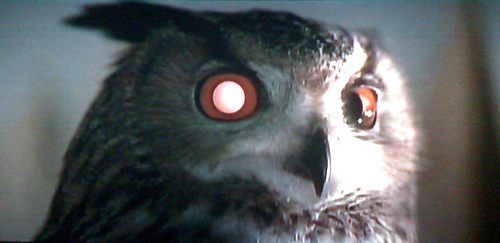
It’s a truism that cinematic adaptations often pale besides their literary counterparts. An obvious counterexample is Ridley Scott’s Blade Runner but, off the top of my head, I can’t think of more. For those who’ve only seen the film, it’s well worth reading the Philip K. Dick’s Do Androids Dream of Electric Sheep? to see just how different it is, but to explain some elements of the screen version you’d have to gloss over otherwise.

Read the book to discover why the Blade Runner owl is artificial

A wonderful thing about a book is that everyone’s idea of it is unique. The reader converts the printed word from the page into a world of their own imagination. How I see the Imperial Palace on Melania in my head, is different from any readers of the Johnny Mackintosh books. Perhaps that’s why film adaptations so often disappoint, as the Director is competing with thousands of movies that have already run within a reader’s head.

There’s no film I can remember that’s disappointed me more that Harry Potter and the Half-Blood Prince, directed by David Yates with a screenplay by Steve Kloves. As someone who loves the stories so deeply, it horrifies me that this pairing were also asked to make the double film of the final book. While I think the quality of film-making in Harry Potter and the Half-Blood Prince isn’t terrible (though it is weak), what I can’t fathom were the drastic, totally unnecessary changes to the plot that were introduced, diverting from Rowling’s marvellous story architecture and characterization.

[spoiler alert]

Yates and Kloves think they know better than JK Rowling

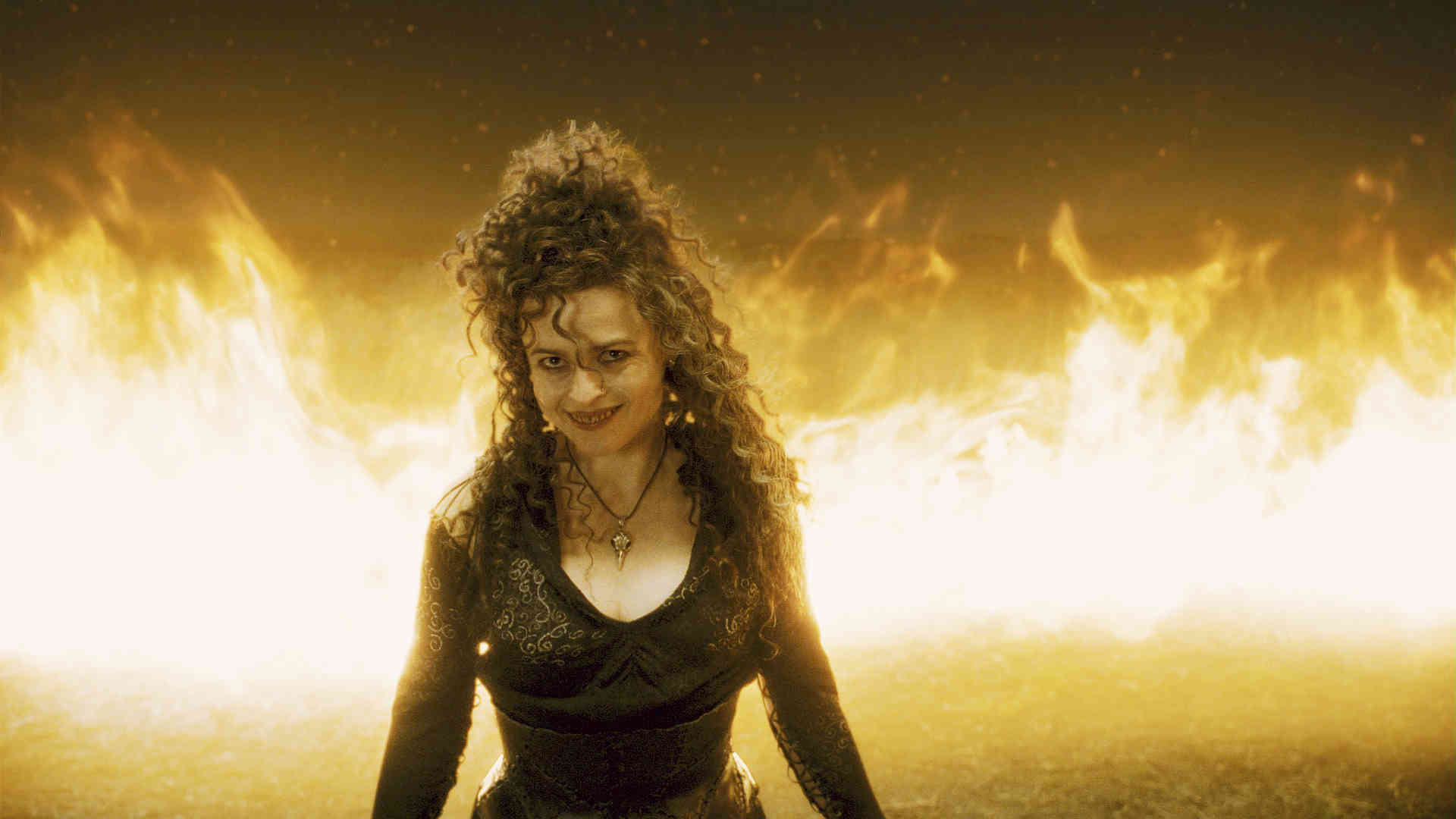
With a long book, why introduce a mad scene where Bellatrix Lestrange destroys The Burrow? Where will they hold the wedding in the next film, or has that been scrapped too?

A more important example was the death of Dumbledore. In the book, Harry is powerless to act, hidden under the invisibility cloak with Dumbledore’s body-bind curse on him. He would do anything to fight to save his pseudo-grandfather figure, and knows all too well the Hogwarts Headmaster is dead when the curse lifts. If the film, Harry is hiding in the background, and chooses simply to watch and not act, perhaps due to some bizarre element of cowardice that Yates and Kloves wanted to introduce into Harry’s character. There are numerous other examples and a lot concerning Dumbledore’s relationship with Harry: in the books, our hero is kept in the dark and has o puzzle things out for himself; according to this film, Harry is Dumbledore’s confidant.

When I write the Johnny Mackintosh books, I confess I sometimes have a secret nod to possible future film adaptations. I know a fair amount about film theory and structure, and sometimes I’ll be particularly proud of a passage because I know how well it would translate onto the big screen. I see the same in Jo Rowling’s writing at times, where she’s gone a little out of her way to write a beautiful, cinematic scene for her directors, knowing how much it would enhance the film. Yates completely ignored this. There are two such scenes in the Half-Blood Prince: the great battle within Hogwarts, as the DA battle the Death Eaters within the castle, and then the set-piece of Dumbledore’s funeral. How could these be missing? It means the film doesn’t even have a proper climax. And it’s given a terrible plot problem for the final film when Voldy has to break into Dumbledore’s tomb.

If you haven’t gathered I feel very strongly about this, then you should. I do wonder why Rowling would have allowed it to happen when she famously controlled the earlier films so tightly. One of my friends did suggest that, by the time Kloves was writing the screenplay, he had all seven books at his disposal so, for the first time she could step back and trust the filmmakers. What a mistake that was.

However, the reason I thought I’d write this piece was having recently seen the movie of Percy Jackson and the Lightning Thief. Now I know many people describe the Percy Jackson books as “Harry Potter lite” and I can understand that. This is the only Percy Jackson book I’ve read and I have to say I rather enjoyed it. The idea was better than the writing, but it was a fun story, lacking a little in dramatic tension (I never felt Percy wasn’t going to get out of his scrapes pretty easily) and Percy didn’t seem to have any qualms or regrets about killing anything. But I like it enough to reread it almost at once.

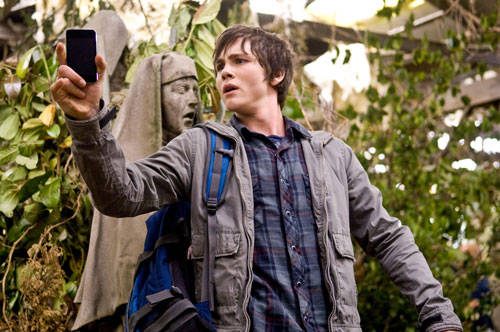
A rare scene in Percy Jackson, staying fairly true to the book

Then I saw the movie. It’s as if the Director (Christopher Columbus) had read a completely different book from me (and everybody else) and had no qualms whatsoever about changing almost the entire narrative. I was left really nonplussed by the whole experience and really felt for die-hard fans of the series, as they must have wondered what on earth they were watching.

The same thing happened with Philip Pullman’s Northern Lights/The Golden Compass, where the story was butchered, almost to the point of becoming unrecognizable, by the filmmakers, ruining everything that was good about the book.

Then, last night I saw the Alex Rider Stormbreaker film for the first time. Apologies to Anthony Horowitz, but I really loathed this book and couldn’t get on with the style of writing at all. Happily for Anthony, he’s done very well from it and certainly doesn’t need my endorsement. I don’t recall that much about the book, but watching the film I was pleasantly surprised and it’s interesting that Horowitz also wrote the screenplay. Here the director (Geoffrey Sax) seems to have gone for some sort of high-camp spoof (hence very comic) adaptation, which work well for what it was.

Peter Jackson's beautiful Minas Tirith

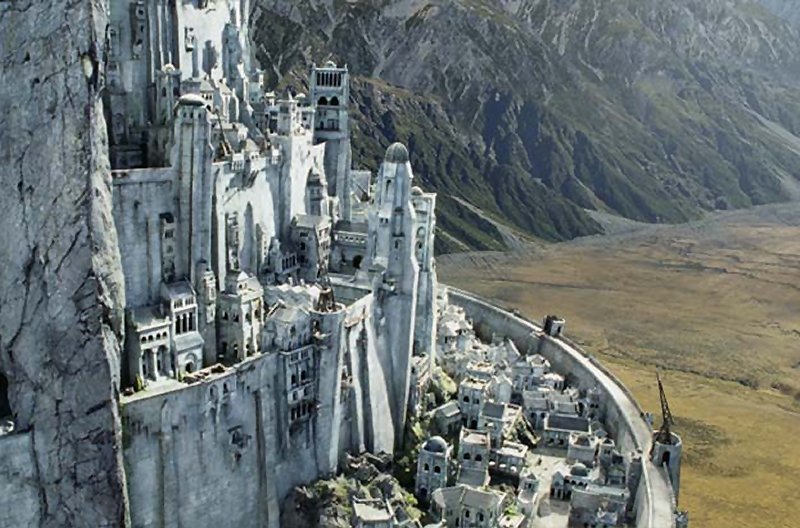
At the start of this blog entry, I commented that Blade Runner is a superb film and completely unlike the book. Is it fair, then, to criticize other movies that diverge from the books they’re based on, attempting to make films that standalone? Yes and no. I’ve not read The Lord of the Rings books since I was 14 or 15, but I devoured them up until that point and always considered them unfilmable. Then Peter Jackson directed one of the most beautiful cinema trilogies ever and fans of the book owe him an incredible debt. I always dreamy I’d see the beautiful city of Minas Tirith first hand and he made it possible.

What I think it comes down to is that, for a hugely popular book, the filmmakers have a responsibility to the fanbase to create something true to the original story. For something less well known, they’re free to take the essence of the story and use it as a basis to create some new work of art. It breaks my heart to say it, but I don’t think there’s any way I’ll watch the final two Harry Potter movies as they’ll just make me angry.

Independence Day

•July 4, 2010 • Leave a Comment

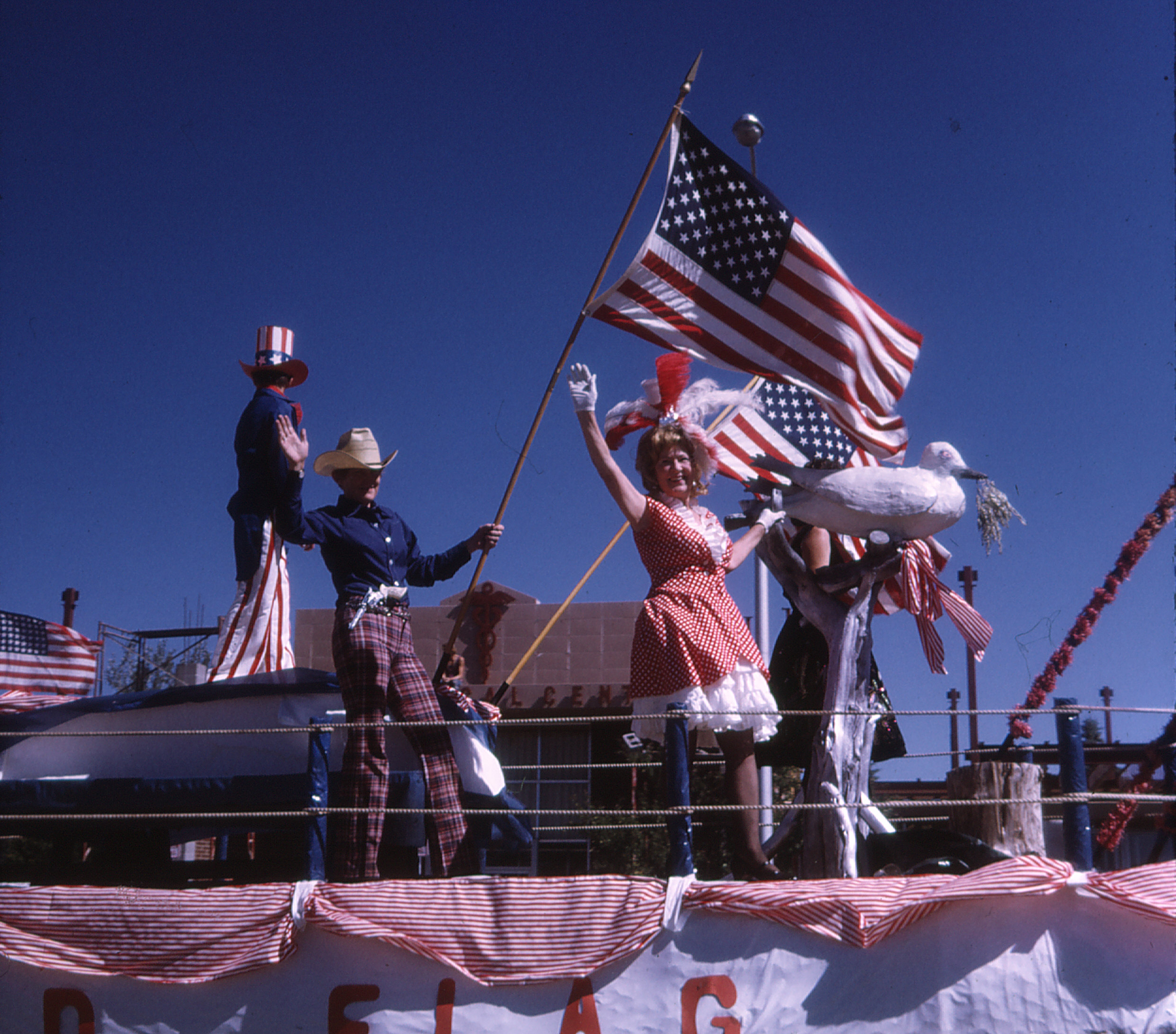
It’s the Fourth of July, the day when the United States celebrates its independence from Britain. When I lived in America as a child, I remember watching a brilliant Fourth of July parade in a town called Cody, Wyoming, home of Buffalo Bill no less.

Nowadays, I can’t hear the words “Independence Day” without thinking of the epic movie, with mankind defeating alien invaders against all the odds. Some of the film is superbly written, including President Bill Pullman’s rousing speech outside Area 51 to his ragtag bunch of fighter pilots, tasked with bringing down an alien mother ship.

“In less than an hour, aircraft from here will join will join with others from around the world and you will be launching the largest aerial battle in the history of mankind. ‘Mankind’ … that word should have new meaning for all of us today. We can’t be consumed by our petty differences anymore … Perhaps it’s fate tat today is the Fourth of July, and you will once again be fighting for our freedom – not from tyranny, oppression or persecution, but from annihilation. We’re fighting for our right to live – to exist.  And should we win the day, the Fourth of July will no longer be known as an American hooliday, but as the day when the world declared in one voice:

“We will not go quietly into the night.

“We will not vanish without a fight.

“We’re going to live on.

“We’re going to survive.

“Today, we celebrate our Independence Day!”

Just thinking about that scene brings a tear to my eye, and it’s especially relevant at the moment as I write the third Johnny Mackintosh book, provisionally entitled Johnny Mackintosh: Battle for Earth. And I know that any great rallying speeches had better hit the spot, just in case Hollywood comes calling for the movie rights.

Happy Fourth of July to all my American friends!

Football in Children’s Fiction

•June 16, 2010 • Leave a Comment

It’s only the early days of the World Cup, but already I’m struggling with the constant bee swarm sound of the vuvuzelas, infusing my every waking moment and beginning to permeate my dreams. It reminds me of a dimly remembered episode of The Tomorrow People, from my childhood, where one of the gang was learning to play the drums (with most other kids in town). It turned out that, when they beat out the same rhythm in unison, it would allow some evil alien to return to take over the world.

In the same way, perhaps the dreadful droning is intended to bring the Krun or the Andromedans or some other aliens down to Earth, visiting South Africa District 9 style, or maybe it’s just an alien conspiracy to send everyone in the world mad so they can more easily takeover. I digress…

The Johnny Mackintosh stories may be about space and aliens, but they’re also firmly rooted in football. Johnny himself lives and breathes footy, and I think it’s important he plays a match in every book. When he time travels in the first book, he even works out what day it is by seeing which football match is on the TV. I’m certain that, if the Spirit of London is home on Earth at the moment, he’ll be watching the games and becoming just as exasperated by the incessant vuvuzelas horns as I am. You could say, what Quidditch is to Harry Potter, football is to Johnny Mackintosh.

I played to a reasonable standard growing up, always captain of school and college and club teams. For me, the football in the books helps ground Johnny’s life on Earth, giving readers something they can relate to. Why does he get dropped from the school team? Why do they always seem to train on cold, wet evenings on exposed playing fields? And isn’t it really unfair Johnny has to run all the way back to the changing rooms to collect the half-time orange segments that no school football match would be without?

I worked really hard to make the description of the actual play within the books both realistic, and even useful for readers wanting to improve their play. But there’s another reason why football is in the books – it’s a lure to draw in the so-called “reluctant readers” into the wonders of the literary world. If people can read, relate to and be excited by my descriptions of playing for the school team, they’ll hopefully start to read other books too.

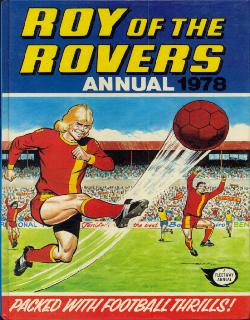
When I was growing up, as well as watching The Tomorrow People I devoured books and comics – of the latter I remember Tiger and Scorcher and its pure football off-shoot, Roy of the Rovers. There were great stories, say about “Billy’s Boots”, that carelessly seemed to get lost at the start of every week, only to be salvaged just in time for young Billy to return to form and score the winning goal. Of course there was also the nonfiction Shoot!, including its classic weekly, “You are the ref” quiz.

Now, with the World Cup upon us, it’s a great time to use football to get kids (and we should remember girls are into football almost as much as boys nowadays) into reading. I hope that the Johnny Mackintosh stories will be one way of doing this, but of course there are other books out there that have football-related themes, so I thought I’d survey them here in case other titles catch your eye.

As a rule, the football-only titles are for younger readers (probably ages around 7-9). As the readership rises, the books still have football, but are about other things as well.

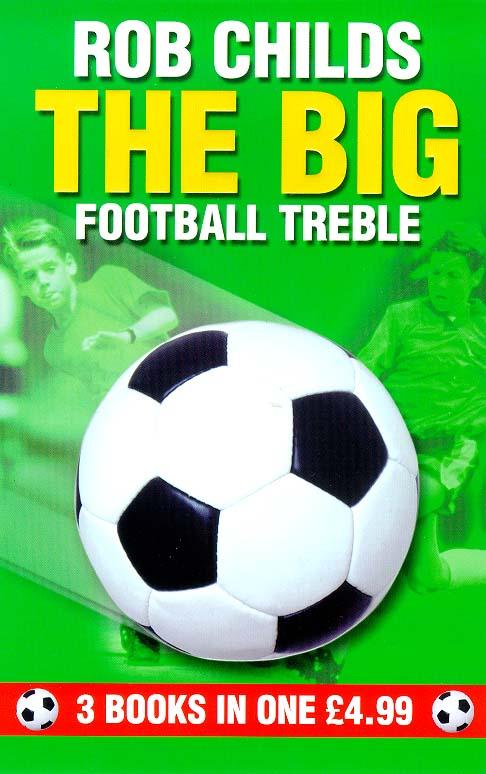
Big Football – Rob Childs’ series (Big Win/Big Fix/Big Freeze/Big Match/Big Prize/etc) follows Danebridge School Captain Chris Weston’s footballing adventures.
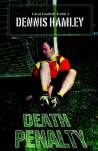
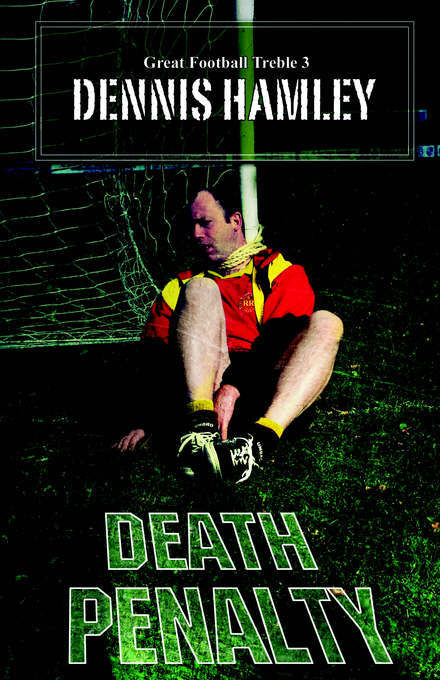
Death Penalty – a murder mystery set in a Championship football club, by Dennis Hamley and Charles Fenoughty.

Exposure – I had the pleasure of hearing Mal Peet talk about this at the Cheltenham Literature Festival one year. Otello, a glamorous South American footballer (together with WAG wife Desmerelda) becomes embroiled in a scandal with Shakespearian parallels.
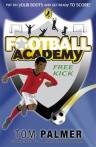
Football Academy – a series for younger readers than the Johnny Mackintosh books, Tom Palmer’s stories follow the fortunes the boys trying to get into Premier League “United’s” academy.
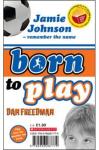
Jamie Johnson – a series by Dan Freedman that sees Jamie graduate from the school team to become a professional footballer.

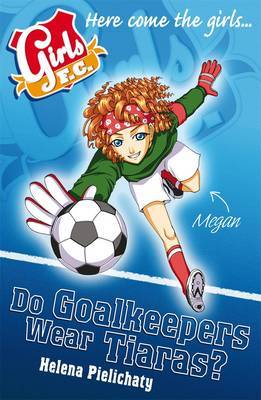
Girls FC – you can follow the Lornton Ladies Under 11 team in Helena Pielchaty’s series, offering a female perspective on the beautiful game (training in a tiara anyone?)
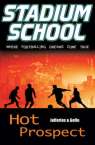
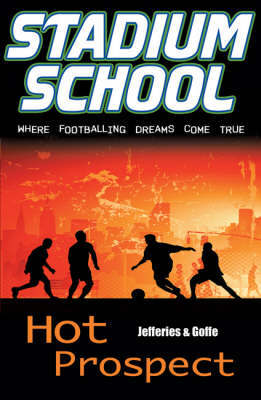
Hot Prospect – young Roddy Jones tries out for a football academy known as Stadium School in an adventure by Cindy Jefferies and Seb Goffe.

Johnny Mackintosh and the Spirit of London – when Johnny’s abducted by aliens on the day of the County Cup Final, you might think he misses it, especially with all the adventures that follow afterwards. But, if you travel through time, anything’s possible, and he still gets to line up for Castle Dudbury Comprehensive against the posh boys of Colchester Grammar in the big match, with its thrilling conclusion.
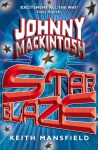
Johnny Mackintosh: Star Blaze – he always thought he was one of the school team’s best players, but Johnny’s been dropped from the school team and is shunned by his teammates. Why it’s happened is a mystery, especially when Johnny’s the set-piece specialist. Watching from the sidelines, it looks as though Castle Dudbury are going out of the cup, but when injuries strike, Johnny has twenty minutes to try to save the day – that’s if his teammates will even pass him the ball.
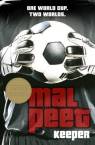
Keeper – a football story with a South American and supernatural theme, by author Mal Peet (who’s also written Tamar and The Penalty). Thanks to Rhodesy the Bear for the recommendation.
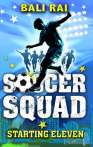
Soccer Squad – this nearly didn’t make the cut, simply for using the “S” word. It’s “football” guys! Bali Rai’s stories are about a local youth club’s football team.

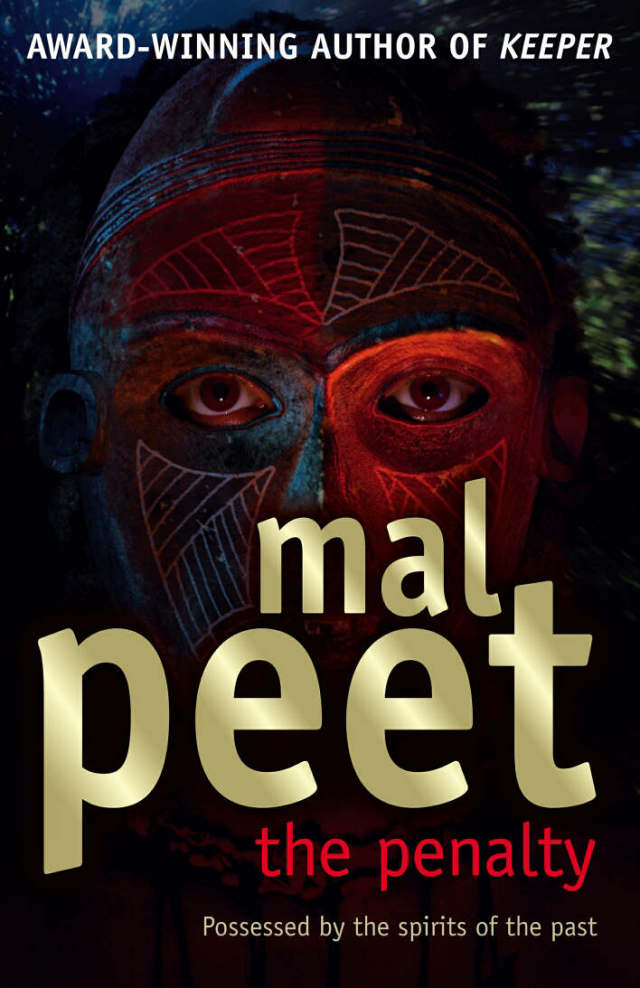
The Penalty – another Mal Peet story that doubles as a South American supernatural  thriller.

TJ –  did spending too much time penning his own football stories mean that Theo Walcott devoted too little to his training and was left behind? I hope not. Aimed at a younger readership than my Johnny Mackintosh stories, TJ and the Hat-Trick and TJ and the Penalty both published in April 2010, with the title character bearing an uncanny resemblance to the young Gunner.

If you have other football-related fiction for children or young adults, please leave a comment and I’ll update the master list.